Virtual First: Architecting Validation Frameworks Before Spending Millions on Physical Aerospace Builds
Virtual First: Architecting Validation Frameworks Before Spending Millions on Physical Aerospace Builds
Look, as an aerospace engineering manager, you know the drill. You’re always trying to innovate, right? But then you’ve got to control costs. The old way, leaning on super expensive physical prototypes for validation, it just drags everything down. It slows development, kills your budget. This guide? It's your step-by-step plan. We'll show you how to move your team to serious virtual validation. You'll cut way back on those costly physical builds. And honestly, you’ll get to market way faster.
Step 1: Define Your Virtual Validation Goals
Okay, first things first: You’ve got to know what you’re actually trying to do with virtual validation. Don’t even think about tools or methods yet. Here’s the reality: It’s all about defining your objectives. We’re talking KPIs for cutting costs, speeding up development, and tackling risks. These are the things virtual simulations should hit. That way, your investment has a clear roadmap, right?
So, to kick things off with this framework, ask yourself: What parts of your aerospace design will benefit most from virtual testing? You should probably zoom in on a few key areas. Like, aerodynamic performance – you want to optimize lift and drag, obviously. Then there’s structural integrity; gotta make sure those components hold up under crazy stress. And don't forget thermal management. You absolutely need to prevent critical systems from overheating. Prioritizing these areas? It just makes your virtual efforts hit the most important design challenges. It's smart.
Next up: Set some real, measurable financial goals. How much do you want to save on physical prototyping? We don't have an exact average cost for aerospace prototypes here. But just think about it: materials, manufacturing, those huge testing facilities, specialized people... it all adds up. Even a small reduction here means a much healthier budget. It just does.
Setting realistic benchmarks for accelerating your development timeline? That's just as important. Think about it: a typical civil aircraft development cycle usually stretches out for between 10 and 15 years. Yikes. Though, some reports show certain aircraft can go from concept to fleet in 4 to 8 years. Your virtual validation framework? It absolutely needs to compress those timelines. We're talking about finding and fixing issues way, way earlier. And finally, dig into your specific risk mitigation needs. What are the big failure points? The safety worries? Virtual testing can hit those long before you even think about manufacturing a single physical component. It’s a huge advantage.
Step 2: Select the Right Simulation Software and Tools
Picking the right simulation software? That’s critical. It’s truly paramount to making your virtual validation framework work. Your choice needs to be based on a few things: how complex is your aerospace design? What specific parameters are you testing? And what level of simulation fidelity do you really need? Make sure your tools can actually model real-world conditions accurately.
So, you’ll evaluate different simulation software categories. Each has its own job in aerospace validation, right? For aerodynamic analysis, you absolutely need Computational Fluid Dynamics (CFD) software. CFD, it uses numerical methods. Algorithms, too. It solves and analyzes problems involving fluid flows. This gives you deep insights into how air hits your aircraft’s surfaces. That's how you get optimal aerodynamic performance.
Now, if you’re assessing structural integrity and looking at stress distribution, Finite Element Analysis (FEA) software is just indispensable. What it does? FEA breaks down tricky structures into tiny, simpler bits. This helps predict how a product will react to forces, heat, vibration, you know, other physical effects. You’ll spot weak points before you even cut material. It’s that good.
And what about simulating the motion and forces of connected parts? Like, rigid and flexible bodies? Think landing gear deploying or control surfaces actuating. For that, Multibody Dynamics (MBD) software gives you super precise insights. MBD tools are absolutely critical here. They help you really understand how different parts of your system interact dynamically. Plus, don't forget specialized thermal analysis software. It's crucial for modeling heat transfer and how temperature spreads across components. That’s vital for keeping things running optimally in those demanding aerospace environments.
Okay, past individual capabilities, you need to think about integration. How well do these tools play with your existing CAD (Computer-Aided Design) and PLM (Product Lifecycle Management) systems? Look, seamless data flow between design and simulation tools? That’s paramount. It cuts out manual transfer errors. Speeds up your iteration cycles. And crucially, it keeps one single source of truth for all your design data. Finally, check out the scalability and cloud options. Can these tools really handle more complex simulations down the line? Bigger datasets? What about the computational demands of future projects? Maybe by using cloud resources? These are big questions.
Step 3: Build a Robust Digital Twin Foundation
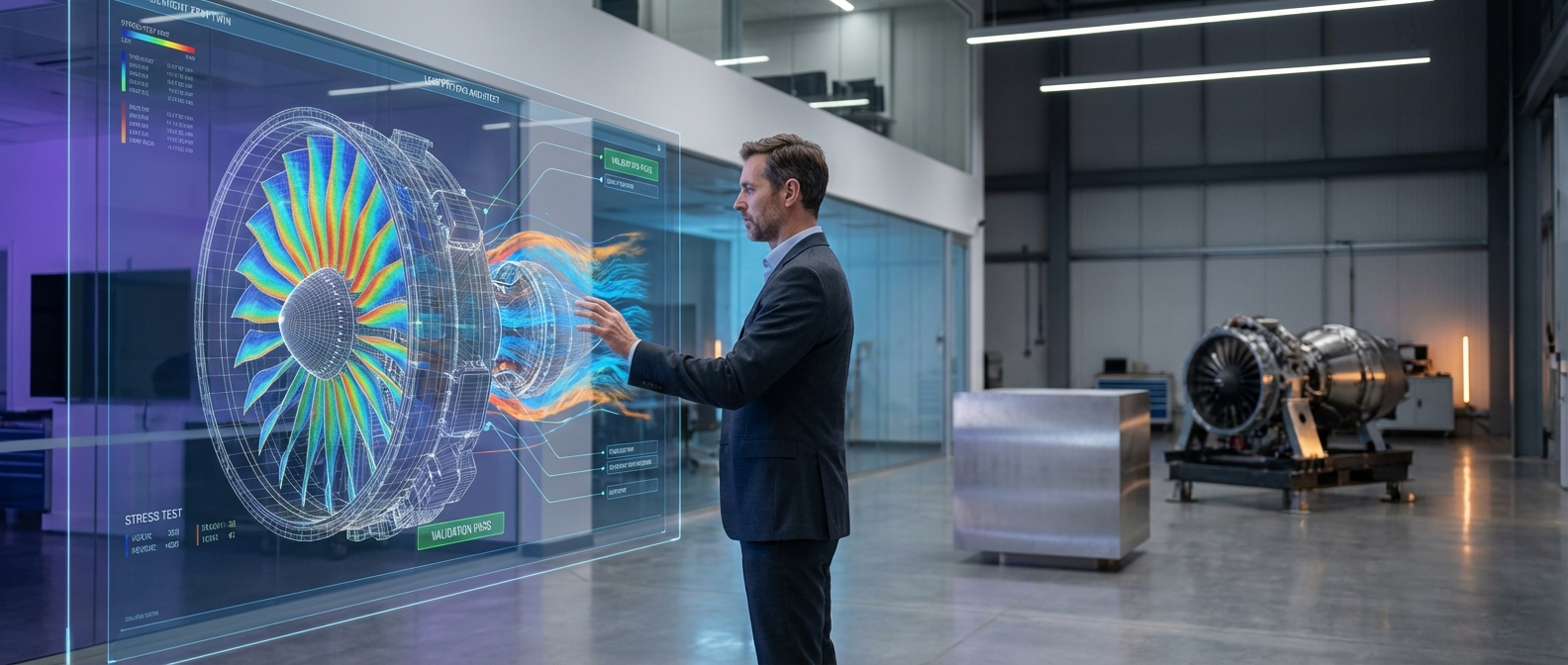
Think of a digital twin as a virtual copy. It's a replica of a real, physical aerospace component or system. This lets you do continuous validation. All through the design and even the operational lifecycle. Honestly, building a strong digital twin is foundational. It sets you up for advanced virtual testing and predictive maintenance. It truly bridges that gap between the physical and digital worlds.
So, building an effective digital twin starts here: What data do you really need from your physical assets? It has to be enough to represent them digitally, accurately. In aerospace, we're talking sensor data, a lot of it. Temperature, pressure, vibration, stress, aerodynamic loads. All that real-world telemetry? It's the critical input. You use it to calibrate and validate your virtual models. This makes sure your digital twin acts exactly like the physical one. No surprises.
Then there's the model fidelity and level of detail. Super crucial for your digital twin. How detailed do you actually need it to be for the simulation to work well? A really high-detail model? Sure, it might be more accurate. But (and this is a big but) it also eats up way more computational resources. You’ve got to find that sweet spot. That balance between fidelity and how efficiently your computer can handle it. It all depends on your specific validation goals.
Here's the kicker: real-time data synchronization. It's what makes sure your digital twin truly reflects the current state of the physical asset. That continuous feedback loop? It’s vital. Essential for predictive maintenance, for those crucial operational insights. We’ve seen it: around 23% of simulation inaccuracies come straight from real-time data sync problems. And get this: if data delays go over 100 milliseconds, your prediction quality drops by 12-17% in time-sensitive ops. That’s a lot. So, investing in strong data pipelines isn't just a good idea. It's the key to keeping simulation accuracy and reliability high.
Step 4: Develop Your Virtual Test Scenarios and Workflows
So, building out your virtual test scenarios? That’s the real core of this whole validation framework. It's how you make sure you're simulating all those critical operational conditions and every potential failure mode. This stage needs really careful planning. You're trying to replicate real-world complexities. And you want to pull out insights you can actually act on.
Start with actual operational use cases. That’s how you define your test scenarios. This means simulating things like flight envelope conditions (think varying altitudes, speeds, different maneuvers). Or ground operations – taxiing, landing, take-off stresses. And definitely environmental stress tests (extreme temperatures, humidity, icing, all that fun stuff). Each scenario should basically be a mirror of what your aerospace component or system will hit in the real world.
Next, zero in on parameter variation and sensitivity analysis. This is all about understanding: How do changes in design parameters actually affect performance? You’ll systematically tweak your inputs. That’s how you find those critical sensitivities and performance boundaries.
Here are some common parameters you'll likely vary in your simulations:
- Altitude and Airspeed: Testing performance across the entire flight envelope.
- Temperature and Pressure: Simulating extreme environmental conditions.
- Load Conditions: Varying payload, fuel levels, and external forces.
- Material Properties: Evaluating the impact of manufacturing tolerances or material degradation.
- Control Inputs: Testing system responses to various pilot or autonomous commands.
You should also integrate Failure Mode and Effects Analysis (FMEA) right into your simulation workflows. Look, why wait for physical failures? You can proactively simulate known failures. Even potential failure modes. We’re talking structural fatigue, system malfunctions, sensor errors, you name it. This helps you understand what those failures do to system performance. And you can design in redundancies or mitigations way, way earlier. Smart, right? Finally, get automated testing and scripting going. That’ll simplify repetitive test execution. It frees up your engineers to focus on the real work: analysis and design iteration. Not just fiddling with manual simulation setup.
Step 5: Establish a Validation & Verification (V&V) Process
You need a strong Validation and Verification (V&V) process for your virtual simulations. It’s absolutely essential. This is how you make sure your digital test results are accurate. And reliable. Before they start informing big design decisions. It’s what connects simulation output with how things actually perform in the real world. And it builds confidence in your virtual models.
One super important part of V&V? It’s the correlation of simulation results with physical test data. Even if you’re “virtual-first,” having some initial physical test data, or even legacy data from old projects, is priceless. You’ll use that real-world “ground truth” to fine-tune your simulation models. It makes sure their predictions really line up with what you actually see. This back-and-forth comparison? It just refines your models. And it builds a ton of credibility.
You’ll also need to define acceptance criteria for simulations. What counts as a “successful” simulation run? Seriously. These criteria should be measurable. And they should connect right back to your initial virtual validation goals. Think specific error margins or performance thresholds you can live with. Plus, doing uncertainty quantification in simulations is vital. Every single model has uncertainties. It’s just how it is. Input data, model assumptions, numerical methods – they all play a part. Understanding and quantifying these uncertainties? That gives you a much more realistic picture of your simulation results. And how reliable they really are.
And finally, set up clear processes for change management for simulation models. Aerospace designs? They’re always changing, right? So, when designs shift, or software updates hit, you need a structured way. A way to update and re-validate your simulation models. This makes sure they stay accurate. And relevant. (Side note: For best practices in V&V for aerospace simulations, check out the prEN 9247 standard. It "compiles best practices for verification and validation (V&V) processes across a wide range of physical behavior models" and really helps ensure credibility for numerical simulation outputs in aerospace. Also, NASA-STD-7009 is a primary framework. It "provides guidelines for developing, verifying, and validating models and simulations used in aerospace systems.") These guidelines are key.
Step 6: Integrate Virtual Validation into the Engineering Lifecycle
Look, you’ve got to weave virtual validation right into your existing engineering lifecycle. Seamlessly. This isn’t just about adding another step. It makes digital testing proactive, not some afterthought. It helps build a culture where you’re always improving. Always catching problems early. And that just optimizes the entire development process.
Effective cross-functional collaboration is huge. Paramount, even. Your design team, simulation team, physical testing team – they all need to work together. Right from the very start. Breaking down those silos? That's how you make sure simulation insights directly inform design decisions. And how you ensure physical tests are planned smart. Planned to validate what you found virtually.
Early and continuous collaboration between design, simulation, and testing teams can drastically reduce late-stage rework and foster a more agile development environment. This shared understanding of goals and challenges unlocks the full potential of a virtual-first approach.
Set up really strong feedback loops for design iteration. Simulation insights can't just be reports, you know? They need to translate straight into actual, actionable design changes. There needs to be a clear path. A way for these insights to really influence the next design versions. That's how you get continuous improvement. Also, put in place knowledge management and best practices sharing systems. Capture all those learnings from your virtual validation work! This institutional knowledge? It's priceless for future projects. And it helps you refine your framework over time. Finally, make training and upskilling engineering teams a top priority. Give your engineers the expertise they need. In advanced simulation tools, in methodologies. Turn them into true experts with your virtual validation framework.
Step 7: Measure and Refine Your Virtual Validation Framework
You need to continuously measure how your virtual validation framework is doing. Against those goals you set. It’s critical for showing its value, right? And for finding ways to make it even better. This isn’t a one-and-done thing. It’s an iterative process. It makes sure the framework grows with your engineering needs. Maximizes its long-term impact.
So, you’ll want to track key performance indicators (KPIs). The ones directly linked to your initial goals. That means documenting how much you’ve cut down on physical prototype iterations. Quantifying the actual cost savings from virtual testing. And measuring how much faster your development cycles are. Don’t forget to track the number of design issues caught early by your virtual validation. That’s a direct reflection of your risk mitigation efforts.
But it’s not just about the numbers. Actively gather feedback from your engineering teams. What practical challenges are they hitting? What’s working really well for them? Their on-the-ground insights are absolutely invaluable. They’ll show you friction points. And where you can improve. Plus, benchmark against industry standards. See how your framework stacks up against the best aerospace companies out there. We’ve seen it time and again: independent research shows companies using advanced virtual prototyping get a real, measurable ROI. They see a 52% increase in engineering productivity, a 27% reduction in development cycle times, and a 26% decrease in physical prototypes. That's like getting an extra month of engineering work every year, just from being smarter about testing. And get this: aerospace orgs using digital twin validations have cut maintenance costs by an average of 28.5% across their fleets. They also boost operational availability by up to 37.2%. That’s huge. Finally, be ready to update your framework. Always. Adapt your methods and tools as technology keeps moving. As your project needs change. That’s how your virtual validation stays at the very cutting edge of aerospace engineering.
References
FAQ
- What are the key benefits of adopting a "virtual-first" approach in aerospace validation?
- A virtual-first approach significantly reduces costs associated with expensive physical prototypes, accelerates development timelines by enabling faster iteration, and mitigates risks by identifying potential failures early in the design process.
- Which types of simulation software are essential for aerospace virtual validation?
- Essential software categories include Computational Fluid Dynamics (CFD) for aerodynamic analysis, Finite Element Analysis (FEA) for structural integrity, Multibody Dynamics (MBD) for system motion, and specialized thermal analysis software to model environmental conditions.
- How does a digital twin contribute to aerospace validation frameworks?
- A digital twin acts as a virtual replica of a physical aerospace asset, enabling continuous validation throughout its lifecycle. It uses real-time sensor data to calibrate virtual models, ensuring accurate simulations for predictive maintenance and operational insights.
- What is the role of Validation & Verification (V&V) in virtual aerospace testing?
- V&V processes ensure the accuracy and reliability of virtual simulation results. This involves correlating simulation outputs with physical test data, defining clear acceptance criteria, and quantifying uncertainties to build confidence in the digital models.
- How can a virtual validation framework help accelerate aerospace development timelines?
- By enabling early detection and correction of design flaws through simulation, a virtual-first approach eliminates the delays associated with waiting for physical prototypes. This iterative testing allows engineers to rapidly refine designs and streamline the path from concept to operational deployment.